
Conservation
Co-ordinating Otter Carcass Collections for East-Central Scotland
Since 2016, we have co-ordinated one of three primary otter carcass collection points in Scotland, taking in over 70 dead otters found across East-Central Scotland and beyond, and facilitating their transfer for post-mortem analysis. Our friends at Cardiff University Otter Project have dedicated over 30 years to examining otter carcasses from across Scotland, England and Wales to investigate mortality factors, screen for disease and contaminants and carry out a suite of broader research on otter biology, population dynamics and whole lot more! Otters are known as an indicator species - meaning anything found in the otter population reflects what's likely to be going on for their environments, which has the potential to be affecting other species, habitats, and humans. The more we learn from post-mortems, the more we can make informed decisions and act positively for otter conservation.
We have been fortunate enough to have been involved in various elements of otter mortality work in the past 10 years, including assisting in post mortems, managing and analysing records, monitoring road death accident blackspots and investigating mitigation options to help reduce casualties. This involves a lot of partnership working, and we have been grateful for so many opportunities to develop and strengthen relationships with other agencies as a result.
In some cases, we find dead female otters who are lactating, meaning they are still likely to have dependent cubs in the area. If we know about the mother, we can work together with other agencies and local communities to try to trace her cubs and get them the help they need.
In order to continue this crucial work, we are reliant on members of the public knowing that it's important to report dead otters, and how to do so.
In Scotland, carcass collections are co-ordinated by the International Otter Survival Fund - who you can contact using the details below. However if you find a dead otter anywhere in Fife, Angus, Tayside, Perth & Kinross, Central Scotland and across the Lothians, you can also report it directly to us. If you find yourselves on Mull, similarly, do get in touch with the team at Mull Otter Group, who'll be best placed to help.
Otters reported to East-Central Scotland Collection Point Jan 2016-2026
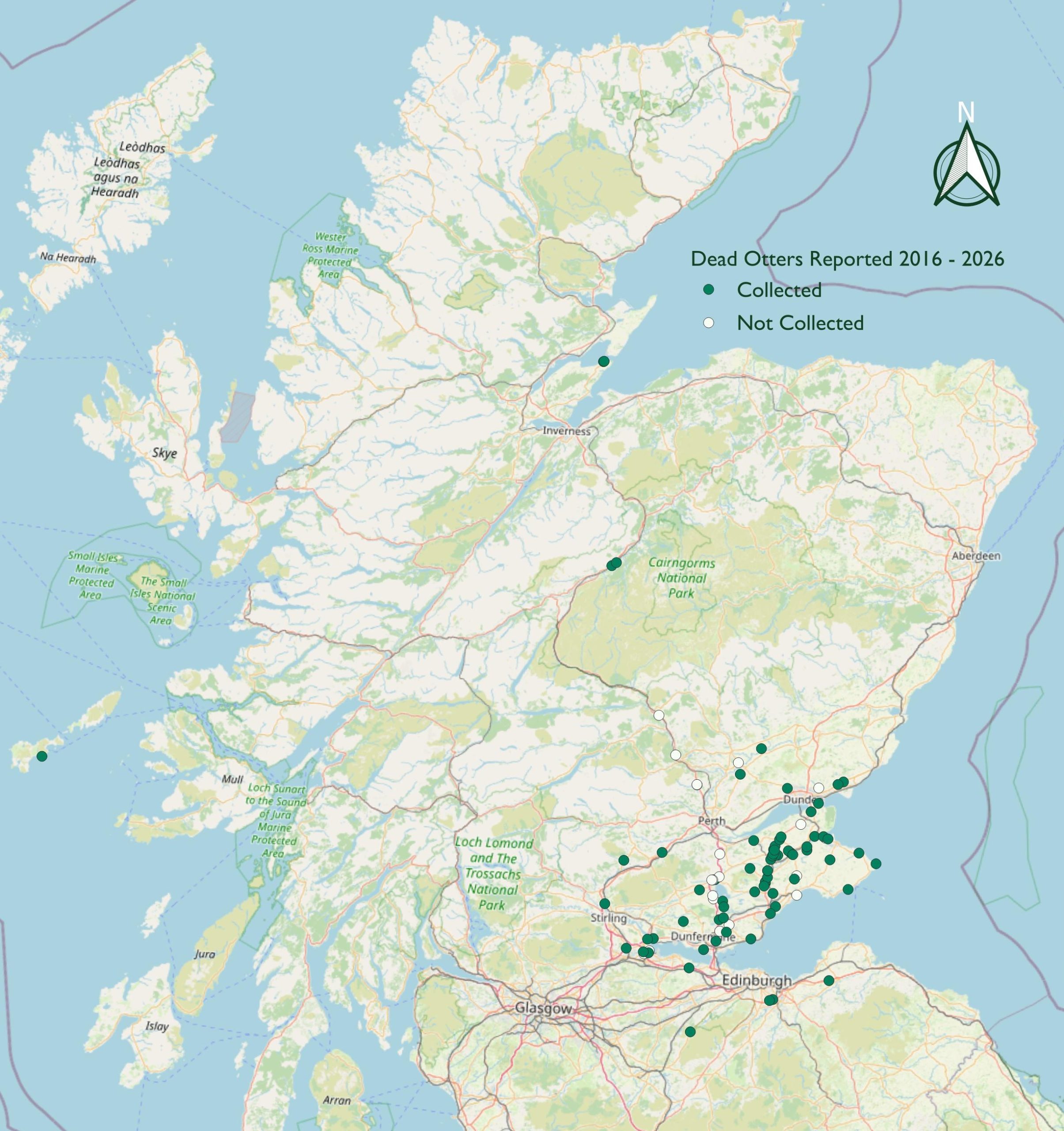
Otter Carcass Data © Lutra Grampia / IOSF / Cardiff University Otter Project
Map data © OpenStreetMap contributors, available under the Open Database License (ODbL)
How to Report Dead Otters in Scotland
If you have found a dead otter in Scotland, please report it to the relevant organisation below, including details of the location (ideally with a what3words address or grid reference), the date and time you found it and as much other information as possible.
International Otter Survival Fund - all Scotland
enquiries@otter.org / 01471 822487
OR
Lutra Grampia - for East-Central Scotland
otters@lutragrampia.org
Mull Otter Group - for Mull and Iona
Follow Cardiff University Otter Project to keep up to date with their ongoing work.
With thanks to staff from the following agencies for their ongoing support:
BEAR Scotland
SRUC Veterinary Services
Fife Coast and Countryside Trust
West Sands Ranger Service
Tiree Ranger Service
Beaver Trust
BASC
Scottish SPCA
and to the zoo community across Scotland.
Population Monitoring & Research
Alongside regularly analysing carcass collections data, we are also involved in monitoring active otter populations across a number of key sites, most prominently across Fife, and are undertaking a long term study into the distribution and behaviour of the Eurasian Otter around the Fife coastline. The results from this project should give us a much better understanding of to what level coastal otter ecology in the east of Scotland relates to what we know of otters from the north and west of the country and how their behaviour is influenced by changes in footfall and other factors across an average year.
Supporting Local Conservation Action
Alongside our own work, we regularly volunteer with various projects across Fife and East Scotland working in the conservation of coasts, rivers and other otter habitats, which helps us stay up to date with new developments and evolving practices, while contributing actively to the landscapes and communities we work in.